


The letter was brief, final, cold and brutal. “Your post as Manpower, Development and Administrative Manager has been abolished with immediate effect.
In a single stroke of a pen, a career was erased, a professional identity dismissed and life was expected to move on – silently. But Laeticia did not accept silence. She knew that what looked like bureaucratic redundancy was in fact institutional patriarchy disguised as economics.
She refused to disappear quietly into the statistics of retrenchment. Instead, she challenged the decision – legally, intellectually and politically, transforming a private grievance into a public confrontation with the system itself. In doing so, she exposed a fundamental truth: institutions do not operate only through laws and policies, but through the people who interpret, bend and sometimes misuse them.
Her fight ended with hard-won victory through a protracted legal struggle. Along the way, she made a deliberate decision to document, to inform, to expose and to educate. In transforming her experience into this book, Laeticia moves from being a victim of injustice to becoming an architect of awareness.
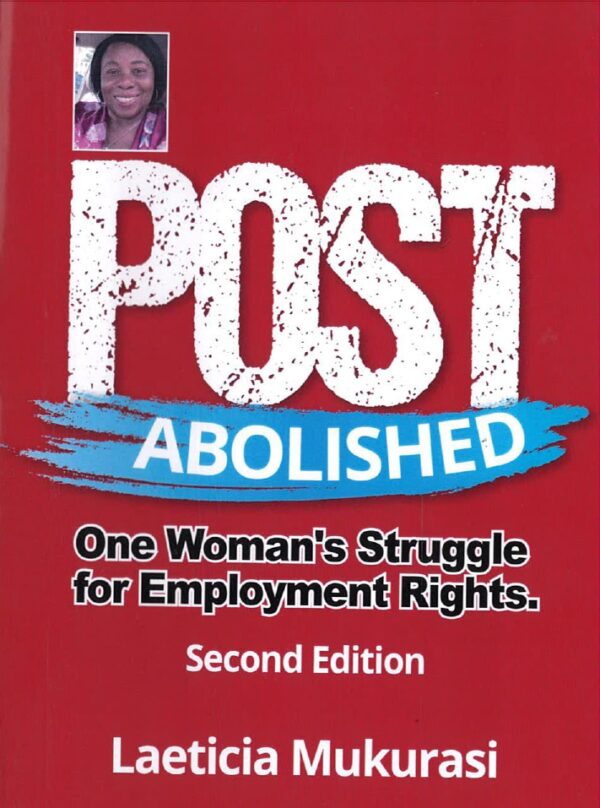
Post Abolished is therefore not merely a memoir. It is a weapon of insight, a record of resistance and a guide for those who must navigate institutions that often appear neutral yet act otherwise. It reveals how laws designed to protect can be undermined in practice and how individuals, armed with knowledge and a will to fight, can push back.
In 2023, nearly four decades after her dismissal, Mukurasi revisited her story in Post Abolished: Second Edition. This was not merely a reprint. It was a re-examination, enriched by hindsight, experience and the subsequent evolution of Tanzania’s legal and policy landscape. The new edition placed her personal story within the broader arc of national reform, particularly the passage of the Employment and Labour Relations Act (ELRA) of 2004. This law introduced mediation and arbitration mechanisms, recognized individual disputes and prohibited gender-based discrimination and harassment, provisions that were, in no small part, influenced by the trail she blazed.
Thus, Post Abolished does not merely narrate history. It traces the process of transformation, linking the shortcomings of the old legal framework to present-day reforms. The book is a reminder that legal change can also emerge from the courage of a single individual.
Laeticia does not simply write to celebrate the past alone. She writes to provoke the present and to prepare the future. The Second Edition amplifies her story through its final chapter, “Passing on the Baton,” which highlights the intergenerational nature of the fight for justice. It speaks directly to young workers entering the labour market, to gender advocates and human rights activists seeking systemic change and to academics and lawyers studying the evolution of labour rights. Employers, too, are called to reflect on fairness, accountability and the long-term value of equitable workplaces.
Reviews
There are no reviews yet.